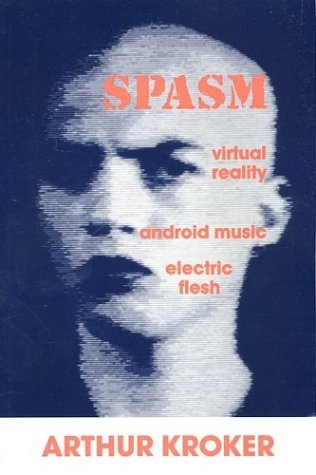
He' s not making it up, goddammit! It's actually out there! As rap songs tell us about real boys in the hood and cyberpunk has its roots in underground technoculture, Kroker's theory-fiction gives us an instant understanding of real media phenomena. The Krokerian eye has virally infected my weltanschauung with apparently permanent effect, confesses Sterling. And I started to believe it too, blessed by the double sign of overloading and excess.If you imprint the words excess, panic, self-cancellation, crash, excremental and spasm into your brain and speak them aloud Kroker-style (not concernedly, not academically, but rowdy and hilarious), they will suddenly come to life in a frightening way: you have entered the fun house of 'virtual America.'
Arthur Kroker is not subtle, does not reassure, and he and Marilouise Kroker are anything but complacent. They assume no superior stance when they write. These texts can be called neither cynical nor critical, but analytical. What they deal with is the state of the social instincts in the age of media. Their studies could fit into the now extinct science of mass psychology, which also availed itself of medical and biological terminology. But the herds and the tribes have fallen apart, and the masses have gone their own way. What is left, sitting in front of its monitor, is the now superfluous instinct, which reappears as 'spasm'. Kroker sees its convulsive, anxious flight movements and upsurges not as a psychosocial issue, but as biotech and as an inextricable component of
'recombinant culture.'
Ours is a floating world; we hip-hop from one thing to the next, as the 1990s' endless series of objections culminates in nothing://its politics intensely violent, yet strangely tranquil; its culture conspiracy-driven, yet perfectly transparent; its media seductive, yet always nauseous; its population oscillating between utter fascination and deep boredom; its overall mood retro-fascist, yet smarmily sentimental.I'm not sure to what extent this stuff is fun to read,//as Bruce Sterling says. Laughing is healthy, and it's fun to see Arthur sitting in a McDonald's in a Critical Art Ensemble video, or doing fieldwork at Disneyworld. Yet there's something terrifying about it all. After Kroker, the carefree enjoyment of mass culture is over; exit cultural studies. 'Cynical commodities' take on a
hysterical character. Consumption is no innocent pastime. Behind the naivetés we discern in malls, amusement parks, dance clubs and tv dens, there must lie a secret force. The Krokerian notation system of 'double irony' ends in the uneasy feeling that something is fundamentally wrong with this world, and that once we are free of criticism and morality we are at the mercy of our own spasms.
Spasm:// the book contains no hermeneutics, as was the case with The Possessed Individual,// which deals with the French postmoderns. The book abandons
the realm of academic discourse and acquaints us with some of the bizarre and romantic techno-gestaltes that populate the early 1990s. For instance, the perfect transsexual woman, Toni Denise, who once said, Men are dumb. I know; I've been one. After becoming a woman on the outside she could finally take on the seduction of the male psyche and become the male mind colonizing the female body. Arthur Kroker plays with the concept 'vague generation', being doctored by Michael Boyce (culturally hip, yet politically reactionary). A description of post-industrial performance artist David Therrien from Phoenix is also included, with his crash machines, fetal cages in which 'techno-mutants' perform rituals of purification.
Spasm features photography by Linda Dawn Hammond (a Diane Arbus of cyberspace, only better), stager of recombinant bodies, ''a carnival of outlaw
bodies, who fetishize the question of sexual identity itself. Arthur Kroker waxes lyrical on them, but I can find nothing unusual in the photographs of thisgenetic sequencer of the body mutant. Shaved heads, piercing, combat boots, tattoos, a Barbie with a penis as bondage fetish: the fun and identity-creating casual wear of the roaring 80s. These are first of all the bimodern bodies, reclaimed at the violent edge of simulation and primitivism, taking us directly into the doubled logic of the virtual body. ''The light blanket of love and peace, drug-tourism and repressive tolerance that hangs over the open-air museum of Amsterdam is evidently veiling my view of what's really going on.
The same can be said of the cd that comes with the book: what musician-programmer Steve Gibson offers us is a perfect parody of run-of-the-mill sampler music, computer muzak for the postmodern environment. But we must not evaluate this product as we would regular independent music. Spasm is a theory cd, probably the first of its kind. The important feat here is that intellectuals are getting to know the inside of a sampler and reporting back. Not only on paper, but on disk, as songwriters and sampled voices. Don't weep for the narrative tradition of Western music, for its opera, chants and symphonies: they've never had it so good. If Mozart were alive today, he would be hard-wired to an Akai s-1000, and would be the first to describe himself as an android processor. Would Nietzsche be putting out cds? Media-conscious texts allude to no larger context, but provide compressed knowledge in the form of sampled aphorisms. Not just music, but the whole world could be radically intercepted by a menu of digitally encoded sound chips. Give us the code, and we can have grunge soap operas, acid jazz news. And punk philosophy.
The Spasm cd isn't house or techno, it's digital dream music for android outlaws. We hear Bush (I don't care what the facts are), Michael Jackson, Gregorian chants and the unbeatable I got the power. This is Duchamp for the ears, a post-referential sound, an endlessly reconfigurable sound matrix, part predator, part parasite. According to Arthur Kroker, Spasm is a 'theory cyclotron.' Each text is a theory anagram, a brilliantly compacted and digitally encrypted political critique. Along with the mood music, there are some real songs here, like the Madonna-Arthur-Marilouise industrial-dance ballad Madonna Mutant,previously released on the Hysterical Male cassette, Will to Power (with violent cries of power, money, lust!) and the bonus track Welcome to the Drug War with the sampled woman's scream All the way to the bottom! Oooohhh! Spasm:// the cd as the very first of the theory anagrams: a dense nucleus of sound-genes, not a degendered world, but a new world of bimodern voices, beyond the epistemic prison-house of the ideologically constituted (sexual) self. //Those interested in the bpm of the 15 tracks can find out more by reading the 'deconstruction,' written by Steve Gibson.
At the end of the book there are essays like Excremental tv (Mediamatic 7#2) and Virtual America, on contemporary Biblical capitalism, with its motto 'Let the Dead Bury the Living.' Kroker advances the thesis that the American self actually forgot to develop an ego. There is no American 'I', only direct violent exchanges between a primal libido and virtual reality. Not a Freudian America, but one after Melanie Klein's model where the self is mediated by object relations and things are fascinating only to the extent that they fall under the sign of exterminism and self-cancellation. Baudrillard Recombinant is Kroker's retrospective of the great master's work. Now that Baudrillard has reached pension age, the question arises of the significance of his thinking in the
era of 'ethnic cleansing' and Germany for the Germans. Now that 'old twentieth-century Baudrillard's' concepts are operating, they've lost their explosive charge. We no longer live in the age of simulation, but of recombinant culture. Morphing replaces seduction, biotechnology the sign, and ecstasy and dread the fatal and always nostalgic play of symbolic exchange. We live in a schizoid culture, marked by two separate worlds, with on the one hand the emergence of technology as a living species existence and on the other the violently pulsating of the social, zero-culture. Yet the run-up Kroker takes to leap over the master's shadow is not long enough. Kroker isn't Baudrillard's part maudite. But Spasm certainly contains some elements for an Arcades project that would map virtual America.
translation laura martz