When you decide to visit a website in your favorite browser, you type an http address. That address points to a server, and your browser opens a connection to pull the site off that server. Once the site is fully loaded, the connection closes.

When you decide to fire up google talk and talk to a friend, your XMPP server finds the address associated with your friend's (jabber) ID and opens a connection to him. This connection stays open, so when you type something, you don't have to wait for his chat client to decide to check whether you posted something. You send it to him directly.

HTTP can also do some kind of persistent connection, but it's hacky. HTTP servers are not made for persistent connections, and they don't scale. HTTP persistent connections also lack addressability: it is unclear which user is connected to an http connection, while users connected to an XMPP server need to authenticate with their jabber IDs.

PubSub: don't pull, push!

Using XMPP, we don't only have to send chat messages. In fact, we can send whatever we want: vcards, audio, flickr enclosures. We want to use XMPP to send XML stanzas containing our anyMeta things from server to server. To do this, will use a publication and subscribe method (PubSub). We can have publishers and subscribers, where a publisher sends a notification to a subscriber each time there is a new stanza to transmit.
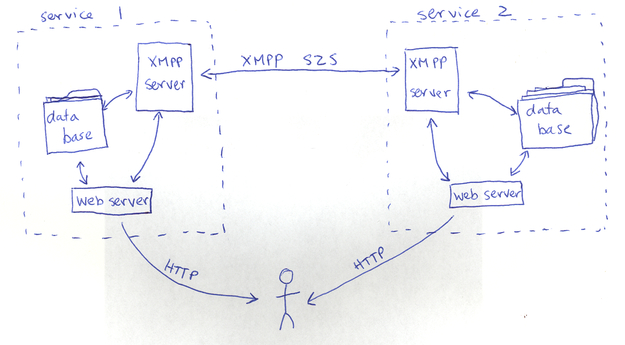
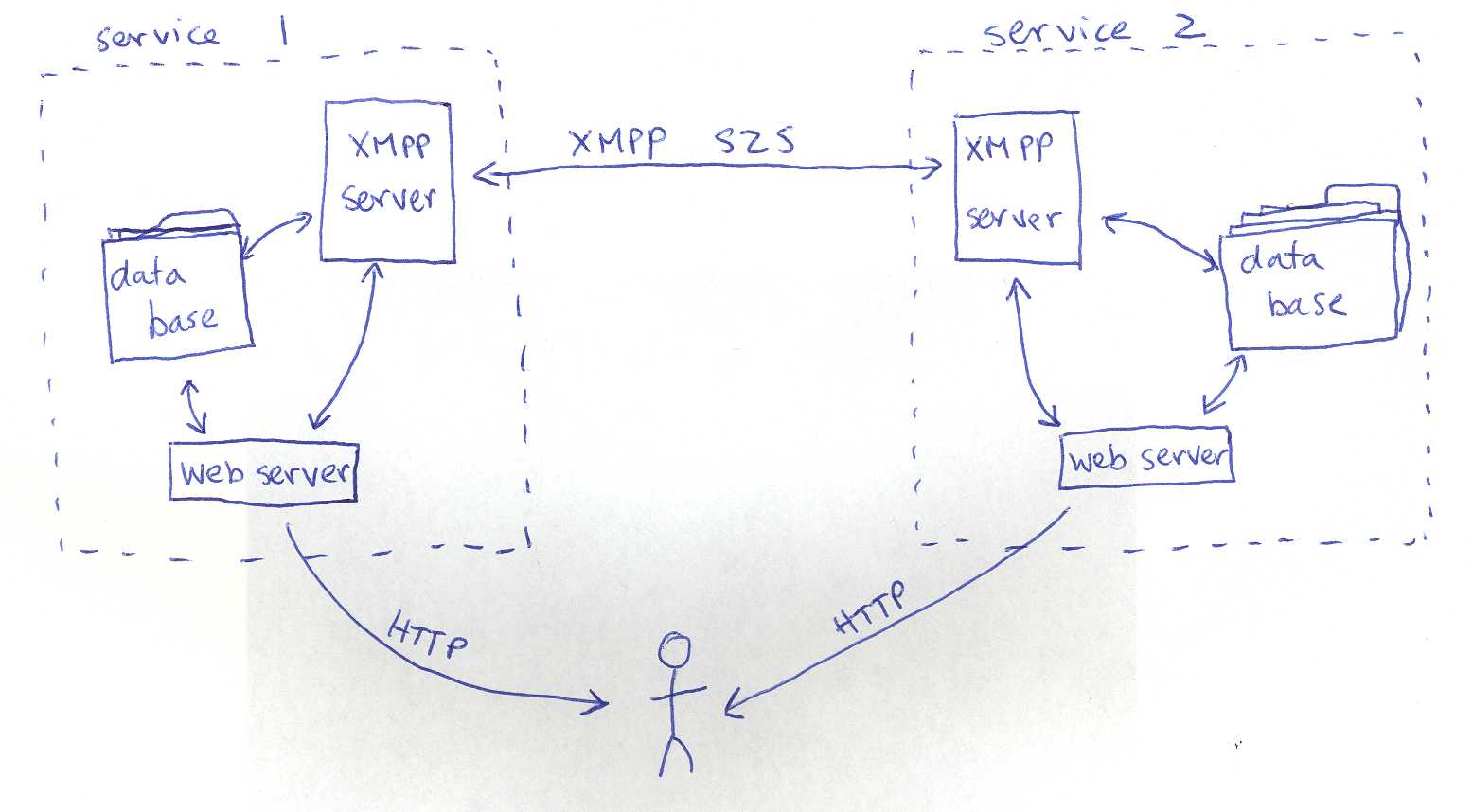
fsn xmpps2s

What does an XMPP message look like?

There are three types of of XMPP messages: a message, an i.q. or identification query (for subscribing, unsubscribing and error messages) and a presence {online, offline, busy}. A message will be what we use to move data from website to website. A message contained in a node, which is what you subscribe to to receive the message. The message is then one of the node items, with its own ID, title and content. It can also contain audio, flickr enclosures or location, whatever you want. Besides containing node items, the node itself also has a node ID and to and from IDs.

What if I don't have my own XMPP server?

fsn xmpp2http

You could also use PubSub as an external service for people who do not have access to an XMPP server.

  • Federating Social Networks

    What was it for?

    Nadya Peek - I'm pretty tired of the fact that every time a new social network shows up on the internet, I end up picking a new user name, a new ...
  • 2Solving Social Network Fatigue

    Social Network sites open up to applications, but how can we make the network our own again?

    Marc Worrell - A social network site is a website where we share some common interest with other people. That interest can be your personal life ( ...
  • Federating Social Networks - The Technology

    Nadya Peek, Marc Worrell - We are proposing a range of existing technologies to enable the federation of social networks. Some are quite new, some are well ...
  • Richard D. James

    alias Aphex Twin

    Nadya Peek - he of many names
  • How to print El HEMA labels

    it's really easy, I promise!

    Nadya Peek - El HEMA printers should be printed on the Mediamatic LAB printer. The Lab printer somehow does color better, as well as paper feeding.
  • User Generated Content Instructions II

    how to write an article

    Nadya Peek - Part two in learning how to use Mediamatic.net. For part one, see the first User Generated Content Manual . If you would like to write ...
  • Review : 

    Een plekje op het internet

    Over het Digitaal Monument Joodse Gemeenschap in Nederland.

    Ino Paap, Nadya Peek - Mediamatic heeft het Digitaal Monument ontworpen en gebouwd in opdracht van het Internationaal Instituut voor de Sociale Geschiedenis ...
  • Review : 

    So what did you SMS?

    transcript from Playing FLICKR

    Nadya Peek - So far during the playing FLICKR installation at club11, the following tags have been SMSed. Leidseplein, Botel, Notcool!, ...
  • Physical Metadata

    tag, tagged, taggers, tagees

    Nadya Peek - Classifying objects is no longer a responsibility for a torturous team of meticulous librarians. On the internet, users freely classify ...