Designing with Organisms
Art, design and bioculture
We're building an urban farm, experimenting with new forms of energy, and exploring biotechnology and eco-culture through art, community and design.
Sprouting Pots Workshop
Help make an artwork
Jacob Raeder is coming to install his beautiful sprouting pots installation at Mediamatic. The work is a series of terracotta pots that have sprouts literally growing out of them. Learn how to make your own living vase by helping Jacob install his artwork. The workshop is free of charge.
Come by the Mediamatic Bank to learn how Jacob makes his pots and to help with the building and growing process of these lovely objects. We will basically be smearing a wet seed-goo on the pots. It will take some patience and attention to details, but it is relaxing process. We will be using our hands, and the seed mucus is rather sticky, though not an irritant, and is pretty nice stuff to work with.
...We want your waste
Soil Garden Project
From August 17-22, NANCE KLEHM, an ecological systems designer, will be in Warsaw to help conduct Pixxe’s SOIL GARDEN PROJECT! Right now they are looking for volunteers.
-
The Soil Garden Project will cultivate soil from waste. Image found on piXXe's website.
The Soil Garden Project will cultivate soil from waste. Using bicycles we will collect and compost organic waste such as food scraps, coffee grounds, cardboard, yard trimmings, and so on from residents, businesses, organizations, and public institutions in the Warsaw neighborhood of Ochota.
They aim to process 8-10,000 liters of waste during the project and turn it into humus for the 2013 growing season. Ongoing, they hope to process up to 1,000 liters per week.
During the project three WORKSHOPS will be lead by Nance: a Soil/compost workshop, a Composting toilet workshop, and an Urba...
Xylinum
A stool of spores
What could future materials and production processes be like?
-
Xylinum -
The properties of this material can be adjusted by changing the genetic code of the organisms.
Photo by Samuel Henne, found on http://www.jannishuelsen.com/?/work/xylium/ [Jannis Huelsen's] website
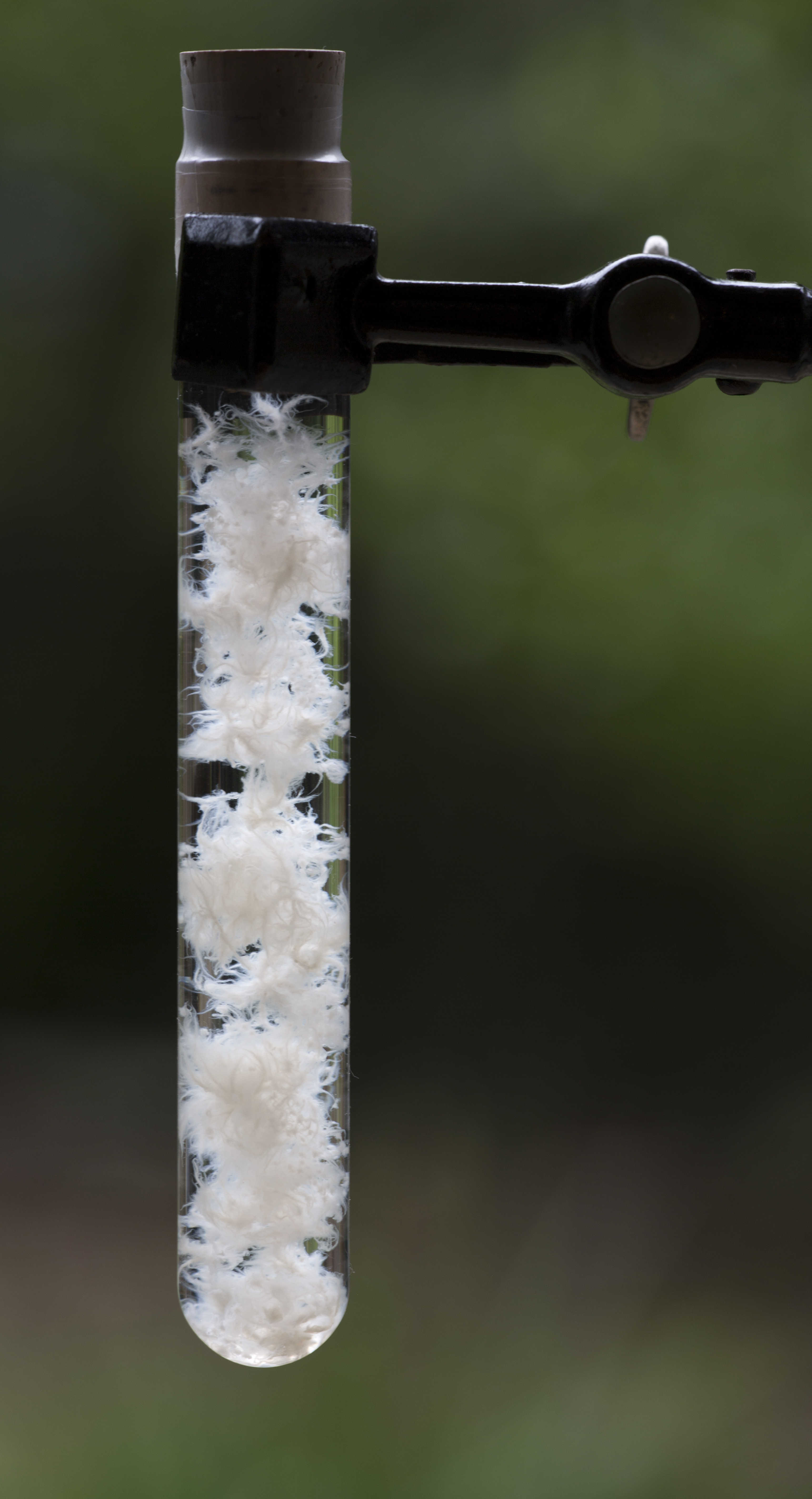
Jannis Huelsen's project is based on a bacterium which produces an artificial cellulose material. This bacterium counsumes sugar and builds a cellulose fibre structure around any given form. Since the process takes place in a nutrition liquid, the wet material can be dryed later on, resulting in a durable and 100 % biodegradable material. The properties of this material can be adjusted by changing the genetic code of the organisms. In collaboration with the company Jenpolymers , a technique was developed to create a »skin« around a wooden stool frame, f...
Algae as potential to extract bio-oil
-
This kind of bio-oil can be used for automobile and vessels. Image found on Yanko Design's website
-
Design -
Sustainable project by : yi liu + Luo Jing + Jiang Yu-ning. Image found on Yanko Design's website.
Green Transformer design by Yi liu + Luo Jing + Jiang Yu-ning is a solar powered floating device that combines algae with a chemical additive and derives bio-oil on the spot. It is a split-type product and the oil tank can be separated from the main body.
Eco-Pod
Temporary vertical algae bio‐reactor
Eco‐Pod made by prefabricated modules. The pods will serve as bio‐fuel sources and as micro‐incubators for flexible research and development programs.
-
"Eco-Pod project by Höweler + Yoon Architecture and Squared Design Lab" -
The Eco‐Pod is also a research incubator in which scientists can test algae species and methods of fuel extraction. Image found on Höweler + Yoon Architecture's website.
Eco-Pod project by Höweler + Yoon Architecture and Squared Design Lab is a proposal for the integration of architecture, new technologies and public space in an ecologic way.
Micro‐algae is one of the most promising bio‐fuel crops of today, yielding over thirty times more energy per acre than any other fuel crop. Unlike other crops, algae can grow vertically and on non‐arable land, is biodegradable, and may be the only viable method by which we can produce enough automotive fuel to replace the world’s current diesel usage. Algae farming...
Constructed of recycled wood, its exterior walls are surrounded by planters with wheat grass growing on them.
-
Transform Bar in the gallery space -
The walls are planter boxes of wheat grass. Image found on Pop up City's website.
Kacey Wong's project Transform Bar is a juice bar that got inspired from the Hong Kong street hawkers’ stalls. With the functional piece of art represents the importance of urban adaptability and the idea of support a healthy sustainable street food style.
...
WikiCells
Imagine juice, yogurt, ice cream, fruit wrapped in delicious natural edible packaging.
Wikicells enclose food and drink inside soft skins.
-
WikiCells, self-contained, edible packaging for liquids, mousses and emulsions. Image found on Coolhunting's website. Phase One Photography
WikiCells are not gadgets. They were created with the aim of reducing overwrap waste, making the most of the available natural resources. The membrane that houses the various WikiCells flavors is made from vegetal elements, with a taste deliberately paired to match its contents. WikiCells’ skin is 100% natural and edible, offe- ring added value to the taste of the product it encapsulates. The gelatinous skin of the WikiCell, while for the most part created from natural particles, does have some hard science in the form of biochemical polymer chitosan and alginate, or algae extract. The hard shell of the WikiCells, which protects the for...
Photoelectric bites
Temporary photoElectric Digestopians Worklab Series
Edible Solarcells
Bartaku's project fused cooking and solar tech. It consist of experimentations on the transformation of light energy into electric energy with food. Often photovoltaic-tech is compared with the plant leaf's capacity of harvesting the Sun's energy. But there is only one type of PV-cell that mimics significantly the natural process of photosynthesis: the natural Dye Sensitized Solar Cells (nDSC). It is made of the dyes of anthocyanin or carotenoid-rich fruits like berries, currants, black beans etc., some titanium-dioxide (cf. white paint, toothpaste) some graphite or carbon and an electrolyte, ...
DIY Energy Harvester
How can citizens use the surplus energy supplies?
DIY kit to discover, capture, and transform sunlight and light pollution.
-
Just follow the instructions and you will have a DIY Energy Harvester Kit.
Image found on Energy Harvests' website.
-
Energy Harvests' DIY kit provides all the components and visual instructions on how to put everything together. What would local micro-power-networks, where free energy can be collected, distributed and exchanged, look like?
Portable Harvesters
Harvesters to carry along
Neighbourhood Satellites Energy Harvests is a project
by Hanspeter Kadel and Myriel Milicevic. This is a set of five different harvesters that can be carried along for the everyday energy harvesting in the city.
Neighbourhood Satellites Energy Harvests examines the practical as well as theoretical possibilities of an alternative, decentralized supply of energy.
...
Marta
Barbara
Anna
Maurizio
Sander